
Prostate Adenoma (BPH) or Cancer? Overlapping Symptoms and Distinguishing Tests
Weak stream, nocturnal urination, PSA: benign prostatic hyperplasia and prostate cancer cannot be diagnosed on symptoms alone.

Dr Najib Abakka
Urological Surgeon in Rabat
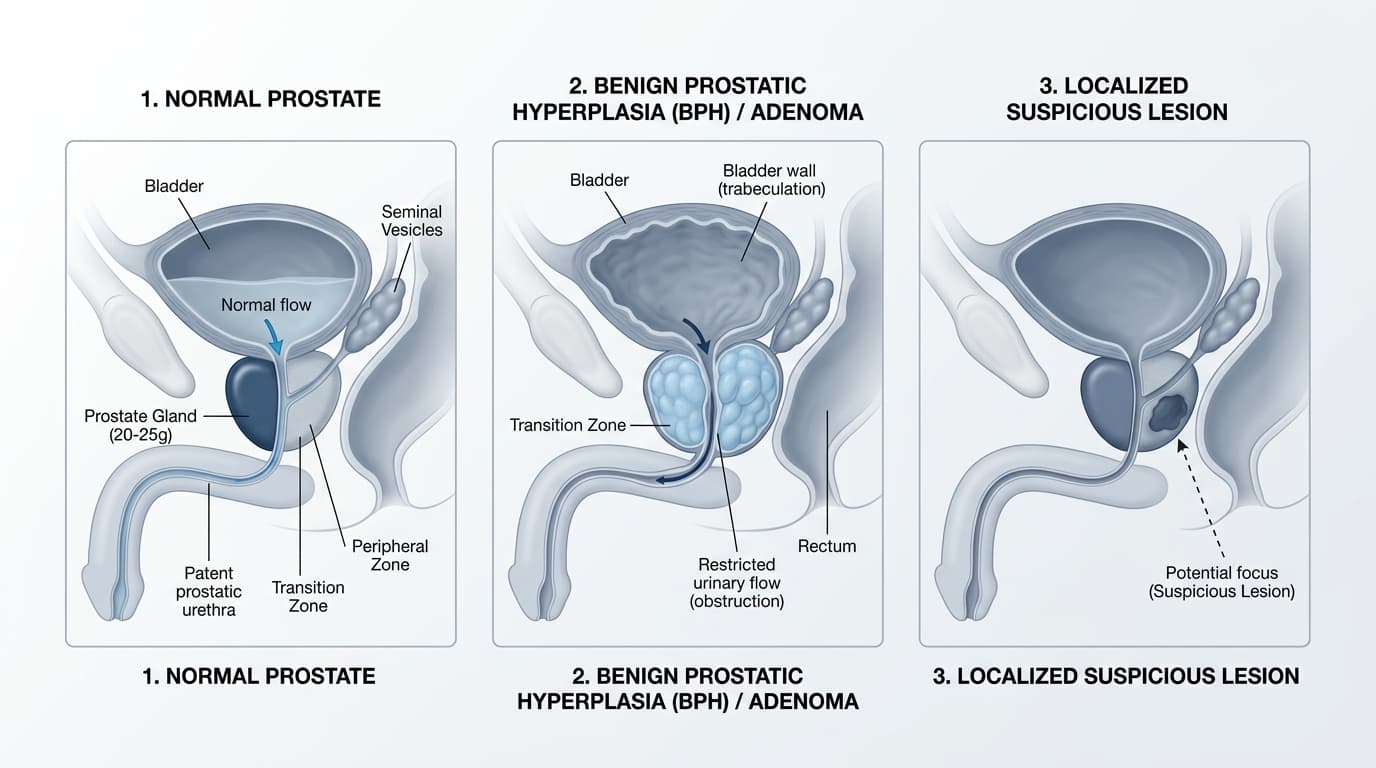
Distinction clinique et radiologique entre hypertrophie bénigne (HBP) et cancer de la prostate
BPH: A benign enlargement of the prostate transition zone
With aging, the prostate gradually enlarges in its transition zone, compressing the surrounding urethra. This leads to common lower urinary tract symptoms (LUTS): weak stream, urinary frequency, nocturia, urinary urgency, and sensation of incomplete bladder emptying.
Symptoms do not directly correlate with absolute prostate volume. A mildly enlarged prostate can cause substantial obstruction in some men, while a massively enlarged gland may remain relatively symptom-free in others.
Prostate cancer: frequently silent in early stages
Early localized prostate cancer originates primarily in the peripheral zone away from the urethra and rarely produces urinary obstructive symptoms. Evaluating prostate cancer risk requires multiparametric assessment: total and free PSA, digital rectal examination, family oncologic history, age, and, when indicated, multiparametric MRI.
Conversely, having a weak stream does not imply cancer. Disentangling these conditions avoids unnecessary anxiety.
PSA alone does not cleanly separate benign from malignant
PSA is prostate-tissue-specific, not cancer-specific. Benign enlargement, urinary infections, urinary retention, and instrumentation can all elevate PSA levels. A PSA value must always be evaluated in conjunction with prostate volume (PSA density) and longitudinal kinetics.
When clinical risk warrants investigation, multiparametric MRI (mpMRI) identifies suspicious PI-RADS lesions and directs fusion biopsies, avoiding blind random tissue sampling.
Treatment for an adenoma is entirely distinct from cancer care
BPH is managed through lifestyle modification, medical therapy (alpha-blockers, 5-ARIs), or endoscopic desobstruction (enucleation, resection, vaporisation) to restore free urination. In contrast, prostate cancer management is determined by risk stratification (ISUP grade, stage, PSA) and encompasses active surveillance, robotic radical prostatectomy, or radiotherapy.
De-obstructive surgery for BPH is entirely different in technique and intent from radical prostatectomy for oncological cure.
Frequently asked questions
Does a large prostate adenoma transform into cancer?
No. BPH and prostate cancer are histologically distinct entities originating in different zones of the prostate; however, they can coexist within the same patient.
Do urinary symptoms indicate cancer aggressiveness or stage?
No. Urinary symptoms correlate with mechanical outflow obstruction from the adenoma and do not indicate cancer stage or presence.
Why is multiparametric prostate MRI performed?
Multiparametric MRI differentiates benign hyperplastic nodules from suspicious malignant lesions, guiding targeted biopsies when indicated.
Related guides & articles
Browse all articles
Prostate Cancer: From PSA to MRI, Understanding the Diagnostic Pathway Before Discussing Surgery
An elevated PSA does not automatically mean cancer. Learn how PSA, clinical exam, multiparametric MRI, and targeted biopsy fit together.

Life After Prostate Surgery: Continence, Sexual Health, PSA, and Follow-Up
What to expect after radical prostatectomy? Catheter care, urinary continence, erectile recovery, pathology results, and PSA monitoring.

Robotic Surgery in Urology in Rabat: What Patients Should Know Before Deciding
Understand robot-assisted urological surgery, its clinical indications, limits, and essential questions to ask before deciding.