
Penile prosthesis: restoring an erection in severe erectile dysfunction
When drug treatments for erectile dysfunction are no longer enough or are contraindicated, the penile prosthesis restores rigidity on demand. It is a device implanted in the penis, activated by the patient at the time of intercourse. Sensitivity, orgasm and ejaculation are not changed by the implant. The actual indication is decided in consultation, after a full assessment and a discussion of expectations.
Dr Najib Abakka
Urological Surgeon in Rabat
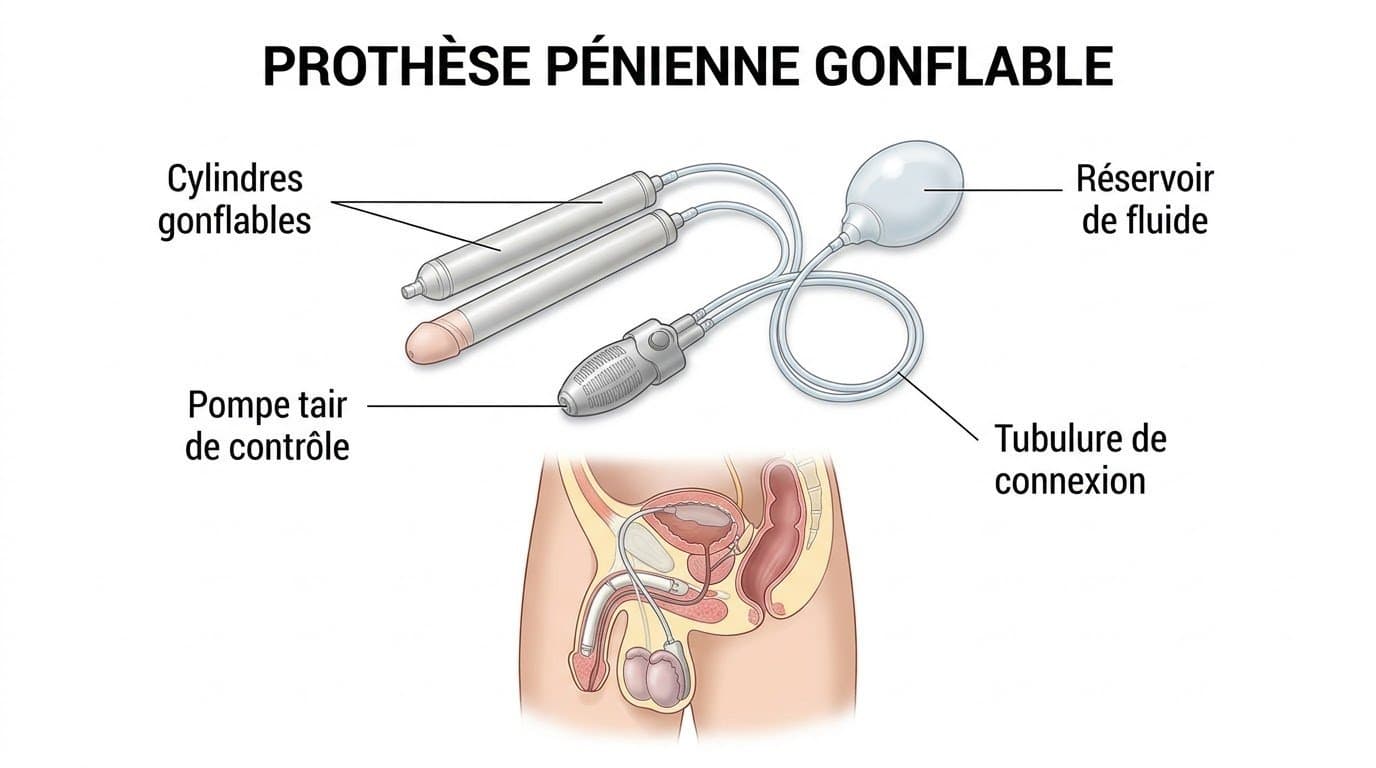
Schéma d'une prothèse pénienne gonflable en trois pièces : cylindres, réservoir et pompe.
When to consider a penile prosthesis?
The prosthesis is for men with severe and persistent erectile dysfunction, when other treatments have failed, are poorly tolerated or are contraindicated: phosphodiesterase type 5 inhibitors (tablets), intracavernous injections, vacuum erection device. It is relevant in particular after prostate surgery, in diabetes with vascular or nerve damage, in Peyronie's disease associated with erectile dysfunction, after priapism or trauma sequelae, and in some vascular or neurological conditions. Before any decision, a consultation assesses the history of the condition, treatments already tried, general health, tissue quality and the patient's expectations, often involving the partner. The prosthesis is a definitive solution: once implanted, the erectile tissue is altered and a return to drug treatments is generally no longer possible. That is why it is offered as a last resort, after documented failure of the other options.
The two types of prostheses
There are two main families of prostheses. The semi-rigid (or malleable) prosthesis consists of two rods placed in the corpora cavernosa: the penis remains permanently semi-rigid, and the patient positions it manually for intercourse or at rest. It is simple, robust, with no mechanical parts, and requires no complex handling. The inflatable prosthesis, most often a three-piece device, best reproduces natural function: two cylinders in the corpora cavernosa, a pump placed in the scrotum and a reservoir of saline placed near the bladder. At rest, the penis is flaccid; by squeezing the pump, the patient fills the cylinders and obtains rigidity, and a mechanism then allows deflation. A two-piece version exists for selected cases. The choice between these models depends on anatomy, manual dexterity, surgical history and the patient's preferences, discussed in consultation.
Assessment before surgery
The preoperative consultation clarifies the cause of the erectile dysfunction, treatments already tried and their tolerance, medical history (diabetes, pelvic surgery, radiotherapy, infections), current treatments (especially anticoagulants) and skin and urinary status. A clinical examination assesses the penis, the corpora cavernosa and the testicles. Further tests may be requested depending on the case (penile Doppler ultrasound, laboratory workup). Diabetes must be controlled and any infection treated before implantation, as prosthesis infection is the most feared complication. The patient is informed of the definitive nature of the implant, of the length obtained (determined by the intraoperative measurement of the corpora cavernosa, with no length gain), of the procedure and of the risks, so that the decision is made with full knowledge.
The operation
The operation takes place in the operating theatre, under general or spinal anaesthesia. The approach is most often penoscrotal, sometimes infrapubic. The surgeon opens the corpora cavernosa, dilates them, measures their length, then places the cylinders; for an inflatable prosthesis, the pump is positioned in the scrotum and the reservoir near the bladder. Current prostheses are most often antibiotic-impregnated to reduce the risk of infection. A urinary catheter is generally left in place briefly. Hospital stay is generally brief, with antibiotic prophylaxis and pain relief.
Recovery
The usual postoperative course combines moderate pain, oedema and sometimes a scrotal or penile haematoma, which resolve within a few days to a few weeks. Wound care and local hygiene are explained before discharge. Sexual intercourse is deferred to allow healing. For an inflatable prosthesis, an activation visit is scheduled at that stage: the patient learns to inflate and deflate the device until he can handle the pump with ease. Return to work depends on the physical activity involved. Regular follow-up is arranged to check healing, proper function and satisfaction.
Expected results
The prosthesis provides rigidity sufficient for penetration, on demand, with no drug onset delay. Sensitivity of the penis, the ability to orgasm and ejaculation are preserved, as the implant affects neither the sensory nerves nor the ejaculation pathways. The erect penile length corresponds to the measurement of the corpora cavernosa: there is no lengthening, and a feeling of shortening is sometimes reported, to be discussed before surgery. Published studies report high satisfaction rates among patients and their partners. The device does not change sexual desire, which depends on other factors.
Risks and alternatives
Risks include prosthesis infection (low with antibiotic-impregnated devices), erosion or extrusion of a component, mechanical failure requiring revision, haematoma, persistent pain and anaesthesia-related risks. In case of infection, removal of the device is generally required, with delayed reimplantation possible. Mechanical failure can occur over time; a further operation then most often allows replacement of all or part of the device. Alternatives to discuss before any implantation are tablets, intracavernous injections, the vacuum device, associated psychological or sexological support, and, in very selected cases, revascularisation surgery. None of these options is definitive in the sense of the implant.
Frequently asked questions
Will I still feel pleasure?
Yes. The prosthesis changes neither the sensitivity of the penis, nor orgasm, nor ejaculation. Only rigidity is provided by the device.
Does the erection look natural?
With an inflatable prosthesis, the penis is flaccid at rest and rigid after activating the pump, which comes close to natural function. With a semi-rigid prosthesis, the penis remains permanently semi-rigid and must be positioned manually.
How long does a prosthesis last?
Mechanical lifespan varies with the model and use; a failure can occur after several years and require a replacement operation.
Will I be able to urinate normally?
Yes, the prosthesis does not act on the urinary tract and does not change urination.
What happens in case of infection?
Infection generally requires removal of the device and antibiotic treatment; reimplantation can then be discussed at a later stage, once the infection has healed.
Is the prosthesis visible?
No, the device is fully implanted. The pump of an inflatable prosthesis can be felt in the scrotum, but it is not visible.
Is there an age limit?
No, there is no age limit as such: what matters is general health, tissue quality and the ability to handle the device.
Related guides & articles
Browse all articles
Robotic Surgery in Urology in Rabat: What Patients Should Know Before Deciding
Understand robot-assisted urological surgery, its clinical indications, limits, and essential questions to ask before deciding.

Prostate Cancer: From PSA to MRI, Understanding the Diagnostic Pathway Before Discussing Surgery
An elevated PSA does not automatically mean cancer. Learn how PSA, clinical exam, multiparametric MRI, and targeted biopsy fit together.

Robot-Assisted Radical Prostatectomy: 12 Essential Questions to Ask Before Surgery
Facing prostatectomy? Here are 12 vital questions concerning surgical indication, nerve sparing, continence, erectile function, and follow-up.